
PUT THE BASICS INTO PRACTICE
A Beginner Home Workout You Can Adapt
This beginner home practice uses two example exercises: sit-to-stand and wall press-ups. Learn how preparation, controlled movement, rest and a gradual finish fit together. Adapt or skip unsuitable movements; this is not a complete full-body workout or a personalised programme.
Published 1 October 2026 · Updated 1 October 2026 · ThriveShape
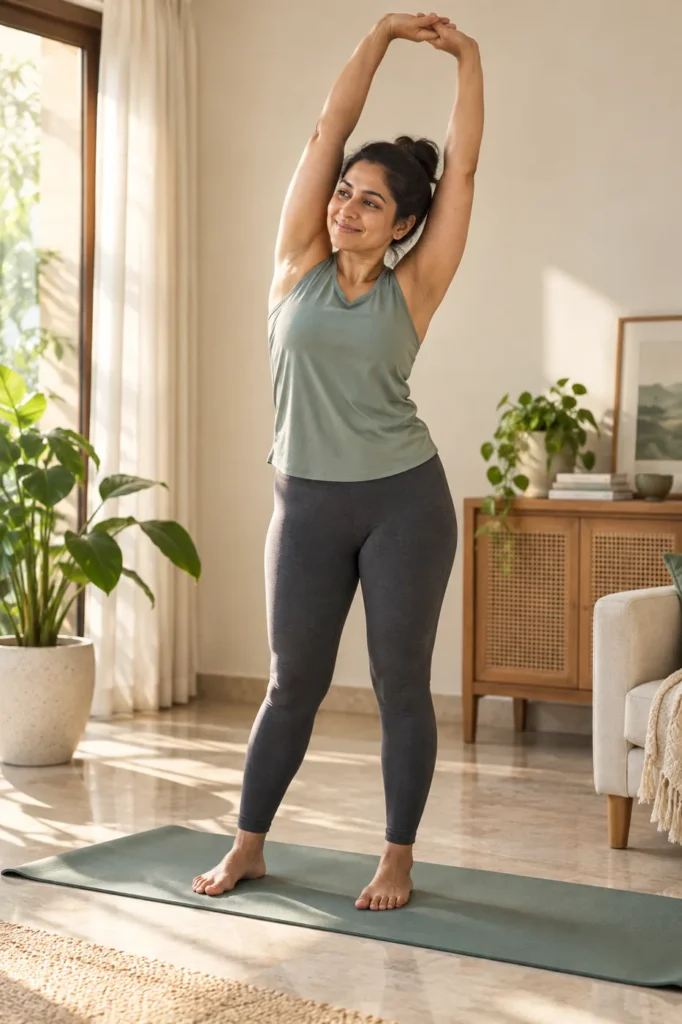
Illustrative editorial image; not an exercise demonstration.
Check that the example fits you
This guide is for generally healthy adults learning familiar home movements. If you have symptoms, an injury, a health condition, pregnancy-related concerns or uncertainty about suitability, get individual advice before using the example. Stop if a movement causes pain or makes you feel unwell.
Read the Home Workouts guide for space and session basics. Decide what you will practise before you start. You can leave out an unsuitable movement; completing a list is less important than choosing an appropriate activity.
Prepare your space and supports
Check that you have room to move and a dry, unobstructed floor. A chair used for support must be solid, without wheels, and must not slip. Use a clear wall for wall press-ups. Keep a phone or timer somewhere you can reach without stepping over cables or equipment.
A gym setup is unnecessary for these examples. Our equipment guide helps you separate the setup you need from optional purchases. Do not substitute unstable furniture for a secure support.
Ease into the session
Begin with easy walking around the room or another familiar gentle movement. Take time to settle into the space, then practise an easier version of the movement you intend to use. The warm-up and cool-down guide explains how to make the start and finish part of your session.
Keep this first practice unhurried. A fixed countdown should not make you skip preparation or rush into an exercise whose instructions are unclear.
Learn two starting movements
The NHS strength exercise guide provides illustrated instructions for both movements below. Read the full source before practising; the brief notes here are reminders, not a substitute for a demonstration or individual instruction.
- Sit-to-stand: start near the chair edge with feet about hip-width apart. Lean slightly forward, stand slowly and return to sitting under control. Keep looking ahead. If you cannot do this comfortably, ask for help choosing an appropriate supported variation.
- Wall press-up: face a wall at roughly arm's length, with palms around chest level. Keep your body straight as you slowly bend your arms, then press back. Use a position and movement range you can control; stop if it hurts.
Use a practice loop, not a race
Try this organising sequence: prepare, practise the first suitable movement, rest, practise the second suitable movement, rest, then finish gradually. You can stop after learning one movement. If you already tolerate both, you may repeat a manageable amount with enough rest to maintain control.
For a conservative first attempt, a few unhurried repetitions can help you learn the setup. There is no minimum score to achieve here. The exact amount should fit your ability; use individual guidance if you cannot judge an appropriate starting point. Avoid turning the example into a fast circuit simply because the movements are familiar.
Finish and record what worked
Move at an easier pace before finishing, and notice how you feel. Write down the movements, support and amount you used, plus anything that was unclear. That record gives you a starting point for the next session without needing a fitness app.
Repeat a manageable version before increasing difficulty. If control or recovery worsens, simplify or rest. Strength Training explains progression, while the workout habit guide helps you make a smaller version for busy days.
Frequently asked questions
Is this a complete strength programme?
No. It is a small practice example for learning session structure. A complete plan needs appropriate exercise choices, progression and coverage for your goals and abilities.
Should I do this every day?
Do not assume that more is better. Leave room for recovery and choose a frequency that suits your current capacity. The beginner guide explains flexible weekly planning.
What if I cannot get up from a chair comfortably?
Skip the example and ask for guidance on an appropriate alternative. Do not force the movement or use unstable furniture to complete it.
A note on individual needs
This page offers general adult fitness education and adaptable planning examples. It does not replace a personal assessment, exercise instruction or medical advice. Read the fitness disclaimer.
How we prepare our guides explains sources, authorship and illustrative imagery. Explore Fitness Guides for your next question.
Keep building your fitness foundations.
Explore Beginner Fitness, Home Workouts and the Fitness Guides for your next practical step.
Published by ThriveShape. AI assistance, sources and review information · Request a correction · Fitness guidance limits.